

Good Grief: How Katy Rogers Turns Grief Into Gold
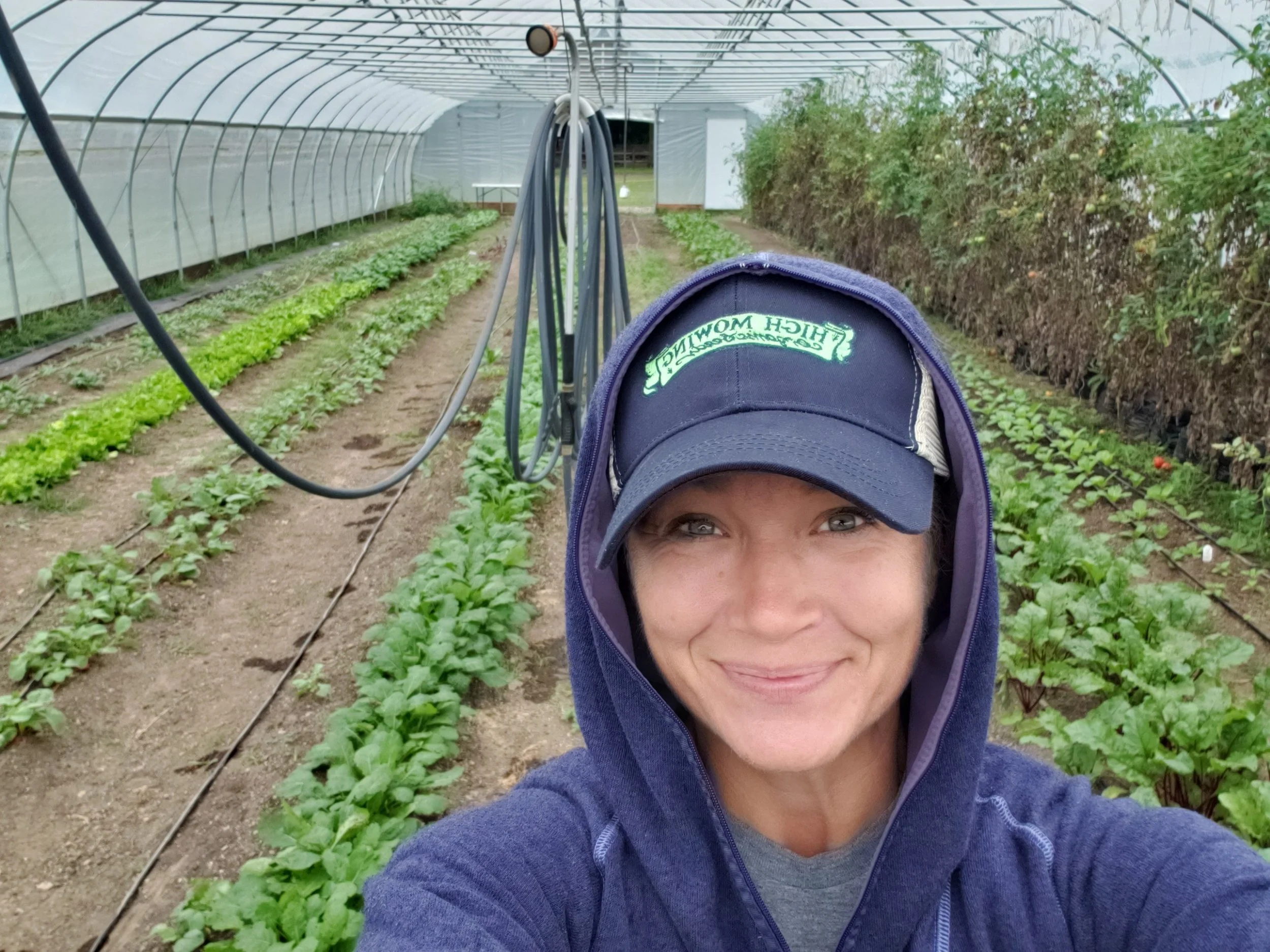
Katy Rogers at Teter Organic FarmThere are moments in life when the picture in your head of who you are no longer matches the reality standing in front of you.
For Katy Rogers, one of those moments came when her son stood taller than she did.
“There’s gonna come a moment,” she told me, “where all of a sudden you realize you’re not the mom of littles anymore.”
She laughed when she said it, but there was something tender beneath the humor. “I hung on to that. I swear I hung on to that so long—until he was taller than me, and I couldn’t hang on to it anymore. And I was like, what the hell? I have big children now. I have to admit I have big children.”
There was something she loved about being a mom of littles. The need. The small hands. The clarity of purpose. Letting that go wasn’t dramatic or catastrophic. It was simply grief.
“I’m going to embrace this,” she said. “But it’s okay to mourn.”
That word, mourn. It doesn’t usually get invited into conversations about toddlers growing up, freshmen in high school and senior portraits. But Katy uses it without apology.
“One of the things I always say to people when they’re embarrassed by how they’re breaking down,” she explained, “What you’re feeling is appropriate for what you’re going through. If there is a time for this, this is that freaking time.”
Grief, in Katy’s world, is not weakness. It is evidence that something mattered. And if you listen to her long enough, you begin to realize that the moment acknowledging her children growing up wasn’t an isolated ache. It was a pattern. Katy’s life has been a series of necessary endings—each one followed by a rebuilding.
“I’ve been in a constant state of rebuilding,” she said during our conversation. “And I’m really happy with how much stuff I’ve been able to let go, and how good it feels to let go of things.”
But letting go is rarely tidy. And it has not always been welcomed.
Katy grew up in a deeply religious and politically active family. As a young woman, she didn’t just inherit those beliefs; she excelled in them. She knew how to say the right things, believe the right things, and become the person the world around her affirmed. “I memorized the propaganda I was taught. Everybody thought I was really smart. I was just parroting people.”
She built a life around that identity and became deeply involved in the world she had been raised to believe in. “I did bad things when I was young in the name of what I believed—not because I was trying to do bad things, but because I was so sycophantic,” she told me plainly.
There was no defensiveness in her voice when she said this. No self-protection. Just clarity.
The unraveling did not happen overnight. It came slowly, through exposure, through experience, and through seeing the reality of real-world systems up close.
“I just couldn’t reconcile the things they were saying with reality,” she said. “I kind of built a life around that identity…and when the dissonance between who I was deep down and the ideas I was espousing just became too great, I just tore everything down.”
Not gently. Not halfway. Tore. Everything. Down.
“It feels like people talk about how hard change is,” she told me. “It’s realizing you need to change and doing the demo work—that’s really the hard part.”
Many people feel that kind of internal fracture and choose to live with it.
Katy does not.
Where some endure the silent torture of living incongruently, she moves.
“Once you get to a certain point,” she said, “the freedom is so amazing to just be like, ‘No. I don’t accept that anymore.’”
“I firmly believe it is each of our job to call out our own in-group,” she said. “So if people identify with me….it’s my job to call out their bullshit.” That posture comes at a cost. “It feels unsafe to have people furious at you,” she admitted.
During our conversation, Katy casually mentioned a podcast she had been listening to—a Jesuit priest talking about the freedom that comes when you stop needing everyone to like you. He described asking Jesus how he could knowingly do something that would make people turn against him. The answer he said he heard was simple:
“Must everyone like you?”
Katy lives like that question has already been answered. That doesn’t mean it’s been easy. Her life exemplifies what happens when the identity that once earned you belonging stops matching who you actually are.
“Honestly, one of the hardest things I’ve had to reconcile with,” she told me, “is that there are people that I have loved and who have loved me that aren’t good people…how do you reconcile that?”
That realization carries its own grief.
“I am an advocate deep in my bones, and I’m an agitator,” she said. “I have had to step into a position where I have to be the person pushing for change.” Then she adds, “There’s been a great sorting in our society. The beauty of my willingness to be disliked is that I have this incredible group of people surrounding me now...It is so much better to have a group of people you’re actually aligned with and pulling in the same direction than the false security of getting along with everyone.”
In the podcast Katy mentioned, the priest also talked about the difference between a “false self” and a “true self; the identities we wear like bandages, so we’ll be approved of, safe, and liked.
But bandages eventually have to come off. Even when it hurts. Which it will. Even when they’re no longer serving you. Especially when they’ve protected you. Katy has done that painful work again and again in her life: acknowledging reality, grieving what was lost, and choosing integrity anyway.
And that work has changed her. Today, Katy talks openly about grief—not just the personal kind, but the civic kind. “I am grieving because of the country,” she told me. “I’m grieving a lot of hope.” And yet she refuses to retreat into despair.
“There’s a breaking point,” she said, “and keeping the peace takes a back seat to protecting what matters. At some point you have to come out swinging.”
She also knows the freedom on the other side of these battles. It is the freedom of someone who has already survived being disliked. Who has already lost what needed to be lost. The freedom of someone who is willing to be furious, or be the target of fury, if that’s what integrity requires.
Grief has marked her life in layers: motherhood, faith, politics, belonging. But she does not calcify around it. She alchemizes it. And what remains…after the tearing down, after the fury, after the letting go…is gold.
She takes the ache of disillusionment and turns it into advocacy.
The discomfort of disapproval and turns it into courage.
The heartbreak of endings and turns it into clarity.
Good grief, it turns out, is not something to avoid. It is something to pass through.
And on the other side of it stands a disarmingly warm woman who will look you in the eye and tell you exactly what she believes; because she has already done the harder work of questioning who she was.
When she talks about mourning the end of being a mom of littles, she is not being sentimental. She is practicing the same muscle she has used over and over in her life: acknowledge what was. Honor it. Let it go. Build again. The day her son stood taller than she did, Katy had to look up. She has been looking up ever since. And she walks forward. Unbandaged, unborrowed, and unapologetically herself.
But Katy Rogers does not believe she is the hero of this story.
“The hero of the story has to be a collective,” she said. “It has to be all of us.”
Because the courage to face reality—to count our losses, unwrap the bandages, and pivot toward something better—is exactly the kind of bravery this moment demands.
After all, as Katy put it: “What is the point, if we’re not trying to leave the world better than we found it?” Interview 2.2.26
Teter Farm grows and shares thousands of pounds of fresh, organic produce each year with families across Hamilton County through CSA shares, farmer’s markets, and local food access programs that help increase access to healthy food in our community. Check out Katy and the phenomenal team at Teter Farm over at 10980 E. 221st Street in Noblesville or at https://teterorganicfarm.com.
Author’s note: Since this interview, I’ve purchased my first farm share and volunteered Teter Farm a handful of times...and I genuinely can’t say enough good things about this place.
I had always assumed a farm share would be more expensive or require a big upfront commitment, but my small share is only $22 a week, with the option to pay, postpone or cancel week by week. For my family of 5, it’s been such a fun way to try vegetables and other organic produce we probably wouldn’t have picked up otherwise—all grown about two miles from my house.
The people have been just as special as the produce. I’ve had the chance to volunteer alongside an incredible group of people who have made me feel genuinely welcomed, and I’ve learned new things every time I’ve gone. If you’ve ever been curious about Teter Farm, I highly encourage you to go get your hands a little dirty and support one of Noblesville’s greatest resources.
